
Guides
How to score a translation agency plan, section by section
Score a translation agency plan section by section as pass, thin or missing, with the test for each of nine sections and the parts that can wait.
Mistake: letting source defects reach the linguists
The most expensive planning failure is leaving source defects for linguists to settle during translation. Incomplete, inconsistent, or incorrect originals can make an English sentence ambiguous across target languages, and linguists may resolve it differently. Set out how defects are reported, when they are raised, and what correction costs.
Source quality determines target quality, yet a plan can skip the response to unclear text. Without a written route, each project may handle the same problem differently, leaving the client and project manager unsure who should act or whether extra work is billable.
Treat a missing method as an operating gap, not a detail to settle after work begins. A written process should make clear when defects are reported and what fixing them costs, so the response does not depend on separate linguists improvising their own solutions.
Handling a defective source text
- Detect ambiguity, gaps, inconsistencies in original
- Raise defects in writing before work starts
- Client confirms or supplies corrected source
- Charge separately if client asks you to fix it
- Log resolution so reviewers stay consistent
Mistake: using a language list to claim coverage
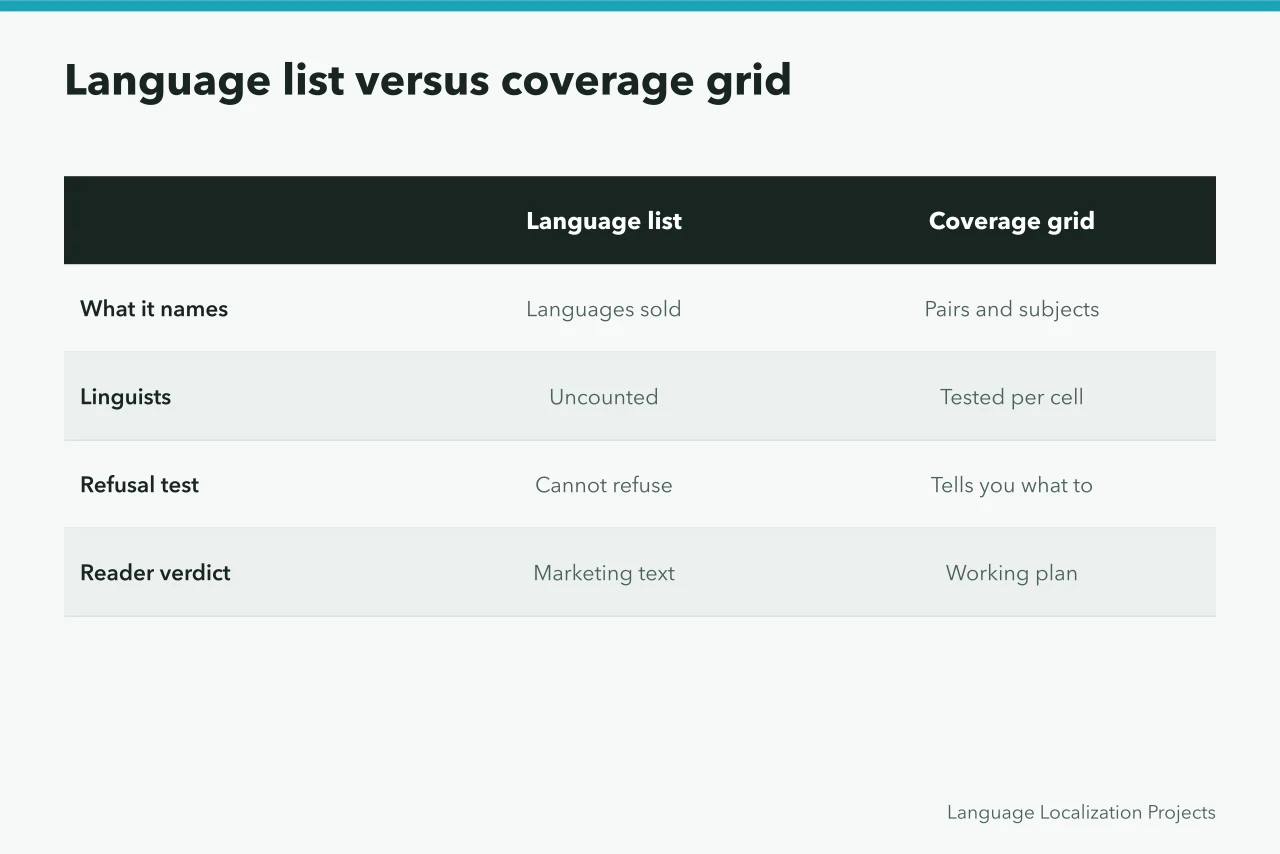
A language list alone cannot show what work the agency can safely accept. Build a grid covering every language pair and subject area you plan to sell, and show the number of tested linguists behind each cell. The grid should reveal the limits of your coverage, not just name languages.
Test the grid by asking whether a stranger could use it to decide which job the agency should refuse. If it cannot support that decision, it is marketing text rather than an operating answer. A plan that names languages without tested linguists or subject coverage leaves its limits unstated.
Mistake: pricing from word count alone
Word count is a billing unit, not a measure of all the work. A plan that gives a per-word rate and stops leaves open what is analyzed before quoting, what is counted, and which items are billed separately.
State the quoting method, including what happens when a client will not provide files in advance.
Write down what is analyzed before pricing and how the count is determined, rather than assuming a word total describes the work. Then build a rate from costs using the agency's own records, so the stated price has an operating basis.
What changes the work behind a quote
- Word countbilling unit, not a work measure
- Repetitioninside a single file
- Memory matchesagainst existing translation memory
- Locked textwords trapped inside images
Mistake: leaving linguistic assets without an owner
Translation memory and termbase gain value with every account, so an improvised answer can become costly when procurement asks about them. State who owns these assets, the format in which they are returned, and how quickly they are returned. Leaving any of those questions open makes the position incomplete.
Do not make the people handling these assets invent terms when a client asks. The software reviewed can help compare tools that store them, but the plan still needs clear ownership and return terms.
Mistake: putting review outside the schedule
A reviewer omitted from the schedule may still appear after delivery, when comments can become unscheduled revision work. Name the reviewer as a role, say whether the review is in-country, set its timing, and specify what happens if the review window passes.
A review section is incomplete if the reviewer appears only after delivery. Make the timing and consequence of a missed window explicit, so a new project manager can follow the planned process instead of discovering an unbudgeted request later.
Mistake: describing capacity as a sales target
Capacity belongs in people and hours, not a revenue target. Record throughput for each pair in an ordinary week and a bad one. If a pair has just one available linguist, that person's calendar sets the real limit, whatever the sales page claims.
If the figure is not yet known, state how it will be measured: which pairs, whose calendars, and how many weeks will be observed. A measurement method is a real answer; an invented figure is not. Plan to hire and train linguists as capacity grows.
Mistake: making promises subcontractors have not signed
Clients in legal, medical, and financial work may ask what subcontractors have agreed to. If the client's confidentiality promise is stronger than the subcontractor agreement, the plan exposes a gap. The fix is to align the agreements, not weaken the client promise.
State what subcontractors sign and what clients are promised, then compare the terms. The contract clauses each side needs to settle can help identify what must match. A written promise unsupported by the agreement remains an unresolved risk.
Mistake: assuming client payments arrive before linguist bills
Linguists invoice on their terms and clients pay on theirs; the time between those dates is part of running the business. A plan that treats cash as a given has not addressed the difference between outgoing payments and incoming client money.
Write that gap down in weeks and make the timing visible before it becomes a surprise in day-to-day operations. The cash flow records describe the four records used to keep the gap in view month by month.
Mistake: waiting until the project archive is large
Decide what is kept, where it is stored, and who can find it a year later while there are ten projects, not four hundred. Without a filing convention, files may end up wherever the last person put them, leaving nobody able to locate a project when it is needed.
Name the records and the filing convention in the plan instead of assuming they will take care of themselves. The IRS says the business you are in affects the type of records needed for federal tax purposes, another reason to settle the records decision.
Mistake: rewarding polished wording instead of usable answers
Score each of the nine sections as pass, thin, or missing. Pass means a new project manager could act on the answer; thin means it reads well but settles nothing; missing means the question was never addressed. A confident tone cannot make an unresolved operating decision usable.
Assets, review, capacity, and confidentiality may sound complete while failing to explain what happens when something goes wrong. Judge each section by the decision it enables, rather than by how persuasive its sentences seem.
Nine plan sections to audit
- Coveragepairs, subjects, tested linguists
- Source handlingincomplete or wrong originals
- Quote methodwhat is analyzed and billed
- Linguistic assetsownership, format, return speed
- Reviewwho, where, schedule, missed window
- Capacityordinary week versus bad week
- Moneypaying linguists before collecting
| Section | Pass when | Thin when |
|---|---|---|
| Coverage | A stranger could use the grid to identify a job to refuse | It names languages and nothing more |
| Source handling | The route for raising defects is written down | The plan says nothing about defective source text |
| Quote method | It states what is analyzed before pricing | It gives a per-word rate and stops |
| Linguistic assets | Ownership and return are settled | There is no answer for procurement |
| Review | The in-country reviewer is a scheduled role | The reviewer appears after delivery |
| Capacity | It is measured in people and hours for each pair | It is stated as a revenue target |
| Confidentiality | Client promises and subcontractor terms match | The promise exceeds the agreement |
| Money | The payment gap is recorded in weeks | Cash is treated as a given |
| Records | A filing convention exists while projects are few | Files are left wherever the last person put them |
A scoring pass should assess what each statement settles, not how confident it sounds. These sample lines distinguish a thin answer from a pass or a missing answer; polished wording can still fail when it gives nobody a usable decision.
| Draft-plan statement | Score | Reason |
|---|---|---|
| All major languages are covered. | Thin | No grid, no named linguists, and no basis for refusing work |
| Linguists are paid on their terms, clients on theirs, and the gap is written down in weeks. | Pass | It identifies the gap |
| Year-two revenue target for German. | Thin | Revenue follows capacity; it does not establish capacity |
| No statement about filing or retention | Missing | There is no way to find a project a year later |
Mistake: treating projections and extra pages as proof
A mission statement, five-year revenue projections, and competitor tables built from public marketing pages do not change a decision. Include projections when a lender asks, not as a substitute for operating answers. A useful market section names buyers you have spoken with and records what they said.
The SBA describes a lean plan as high-level, quick to write, and limited to key elements, while noting that some lenders and investors may request more information. Include projections when required and put their assumptions beside them; the projection itself does not settle how the agency will operate.
When starting a business, keep the plan long enough for all nine sections to answer their questions, and no longer. A new project manager should be able to read it in an hour and then act correctly; adding sections that settle nothing does not improve its usefulness.
Include a standard or certification only if you intend to pursue it, and name the issuing body and what you have confirmed with that body. Naming a standard you have not read risks a procurement conversation, so do not imply confirmation you do not have.
A projection based on a price per word you have never charged and a volume you have never delivered is a wish surrounded by a spreadsheet, not an operating answer. Once the decisions are clear, use the startup decision order to identify what to act on first.