
Guides
Montreal bilingual campaign brief template under Bill 96
A Montreal bilingual campaign brief template with French-first steps, approval gates and a pre-delivery checklist that meets Bill 96.
What to take away
- A Montreal bilingual campaign brief template needs a French first workflow, not a translation step bolted on at the end.
- Bill 96 raises the bar on French commercial content, so the brief must name who reviews French and when.
- OQLF review points belong in the brief as sign-off gates, each tied to a document the reviewer can open.
- The Quebec Enterprise Number field turns a vague client name into a verifiable legal entity.
- A pre-delivery checklist catches the gaps that clients notice first: unapproved French, missing legal review, English-only assets.
What Bill 96 requires of a Montreal bilingual campaign brief
Bill 96 amended Quebec's Charter of the French Language. It strengthened French-language requirements for commercial content in the province, and it gave the Office québécois de la langue française more room to enforce them. For a Montreal marketer, that turns language from a creative preference into a compliance item on the brief.
The statute Bill 96 amended is the Charter of the French Language, CQLR c C-11. Bill 96 was sanctioned on 1 June 2022, and its provisions came into force in stages.
The rule that governs the campaign assets sits in the Charter of the French Language, CQLR c C-11. Section 58 covers public signs and posters and commercial advertising: the French must be markedly predominant wherever another language appears alongside it.
Bill 96 also narrowed the trademark exception. A trademark may appear on public signs and posters and in commercial advertising in a language other than French only if it is registered under the Trademarks Act and no corresponding French version appears in the register kept under that Act. A brief that lets a brand name carry an English headline has to confirm that registration first.
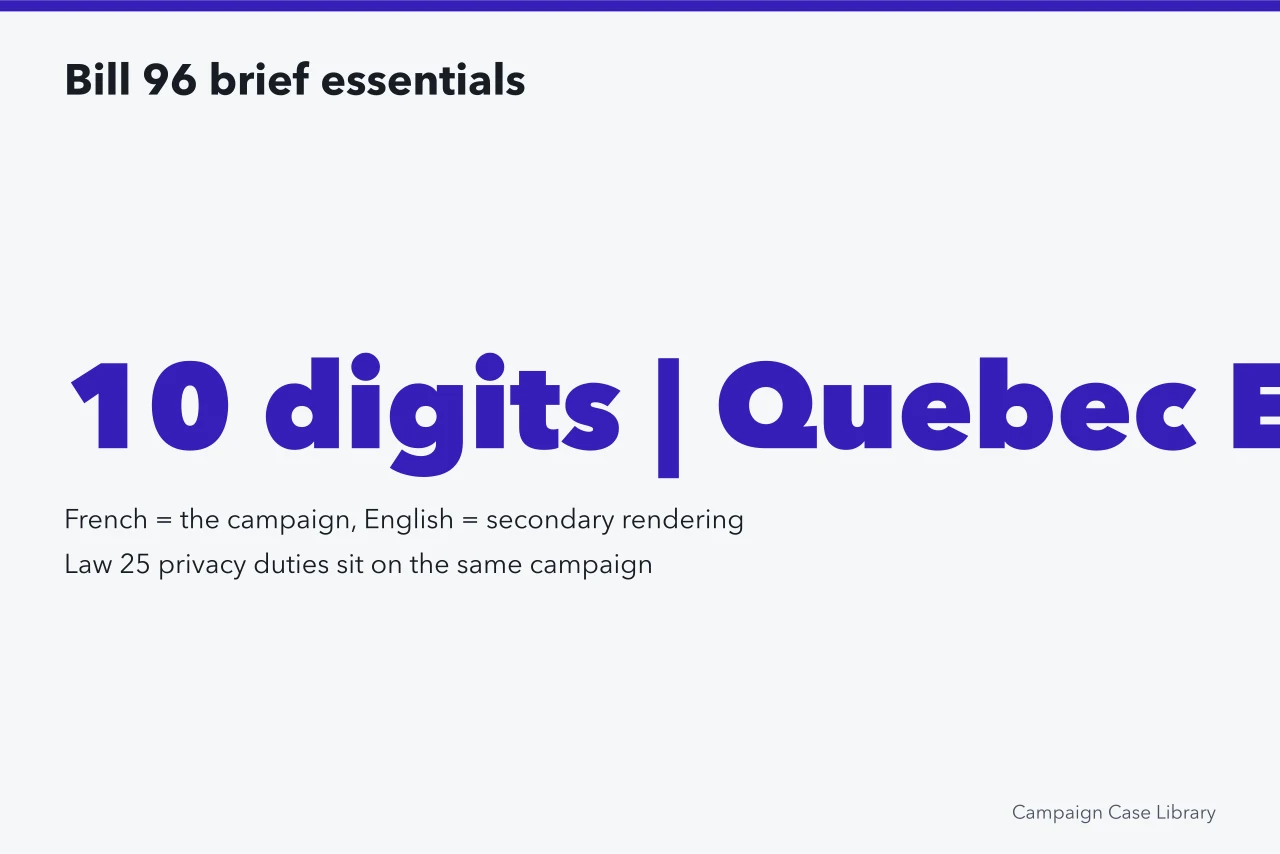
The practical effect is that French cannot be a version of the campaign. It has to be the campaign, with English as the secondary rendering. A brief that treats French as a translation task will produce assets that read translated, and clients in Montreal notice that quickly.
Start the brief with the legal identity of the client. Use the Quebec Enterprise Number (NEQ) field so the team knows exactly which entity is advertising. The NEQ is the ten-digit identifier Quebec assigns to a registered business, and it is searchable in the Registraire des entreprises du Québec, the province's enterprise register.
That matters for two reasons. It confirms the client is registered and trading under the name on the contract. It also gives the team a clean way to check whether the client operates in more than one province, which changes which language rules apply to which campaign.
Quebec's business portal is the starting point for the wider context, including Law 25 privacy duties that sit alongside the language rules on the same campaign. A brief that ignores privacy obligations will stall at legal review, no matter how good the French reads. See the Quebec businesses portal for the market context.
If the client hires staff in Quebec, the brief should also note who internally approves French copy. Hiring and managing staff in the province comes with its own language obligations, and the person who owns French internally is often the same person who signs off on campaign copy.
You can also find an enterprise in the register to confirm the client's legal name before the brief is circulated.
Fields to add to the standard brief
Fields to add
- Client legal name and NEQ.
- Primary marketQuebec only, or Quebec plus other provinces.
- French approval owner, by name and role.
- English approval owner, by name and role.
- Regulated industry flags, such as finance, health or alcohol.
- Required legal disclaimers in French and English.
- Target launch date and the date French copy is due.
A brief without those fields will drift. The team will guess at the approver, the client will guess at the deadline, and the French copy will land late.
Copy the field list below into the brief template and fill every row before kickoff.
Fields to add
| Field | What goes in it |
|---|---|
| Client legal name | Exactly as registered, copied from the enterprise register |
| NEQ | Ten digits, checked in the register |
| Market scope | Quebec only, or Quebec plus each named province |
| French approval owner | Name, role, contact, review window |
| English approval owner | Name, role, contact |
| Regulated industry flags | Finance, health, alcohol, or none |
| Disclaimers | French text and English text, both pasted in full |
| French copy due | Date, plus the approver's review window |
| English adaptation due | Date, after French sign-off |
| Version log | One row per change: date, requester, version affected, action |
The brief template to copy into a working document
Paste this block into the brief document and fill every line before kickoff. It gathers the fields, the sequence and the gates in one place.
MONTREAL BILINGUAL CAMPAIGN BRIEF
Campaign: ______   Version: ______   Date: ______

1. Entity
   Client legal name (as registered): ______
   Quebec Enterprise Number (NEQ): ______
   Verified in the Registraire des entreprises du Québec on: ______

2. Market scope
   Quebec only: [ ]
   Quebec plus (name each province and the assets that run there): ______

3. Owners
   French approval owner (name, role, email): ______
   French copy due date: ______   French review window: ______
   English approval owner (name, role, email): ______
   English copy due date: ______

4. Obligations
   Regulated industry flags (finance, health, alcohol, other): ______
   Law 25 privacy review required: [ ] yes   Owner: ______
   French disclaimers, pasted in full: ______
   English disclaimers, pasted in full: ______
   Trademarks to check against the register before any English-only use: ______

5. French-first sequence (fixed order)
   Write the French source copy.
   French approver approves and dates it.
   Adapt the English from the approved French.
   English approver signs off.
   Legal reviews regulated claims and disclaimers in both languages.
   Freeze both versions; any later change reopens the French gate.

6. Gates
   Copy gate — document: approved French copy — owner: ______ — date: ______
   Asset gate — document: ______ — owner: ______ — date: ______
   Digital gate — document: ______ — owner: ______ — date: ______
   Legal gate — document: ______ — owner: ______ — date: ______
   Final delivery gate — document: ______ — owner: ______ — date: ______

7. Version log
   Date | Change | Requested by | Language affected | Re-approved by
   ______ | ______ | ______ | ______ | ______
Filling the approver and disclaimer lines takes minutes. Leaving them blank is what sends work back after production.
French first workflows inside the brief template
French first means the French copy is written, reviewed and approved before the English copy is finalized. English adapts from the approved French, not the other way around. That sequence is the single change that most improves Montreal campaign quality.
Build the sequence into the brief as numbered steps, so nobody has to remember the order under deadline pressure.
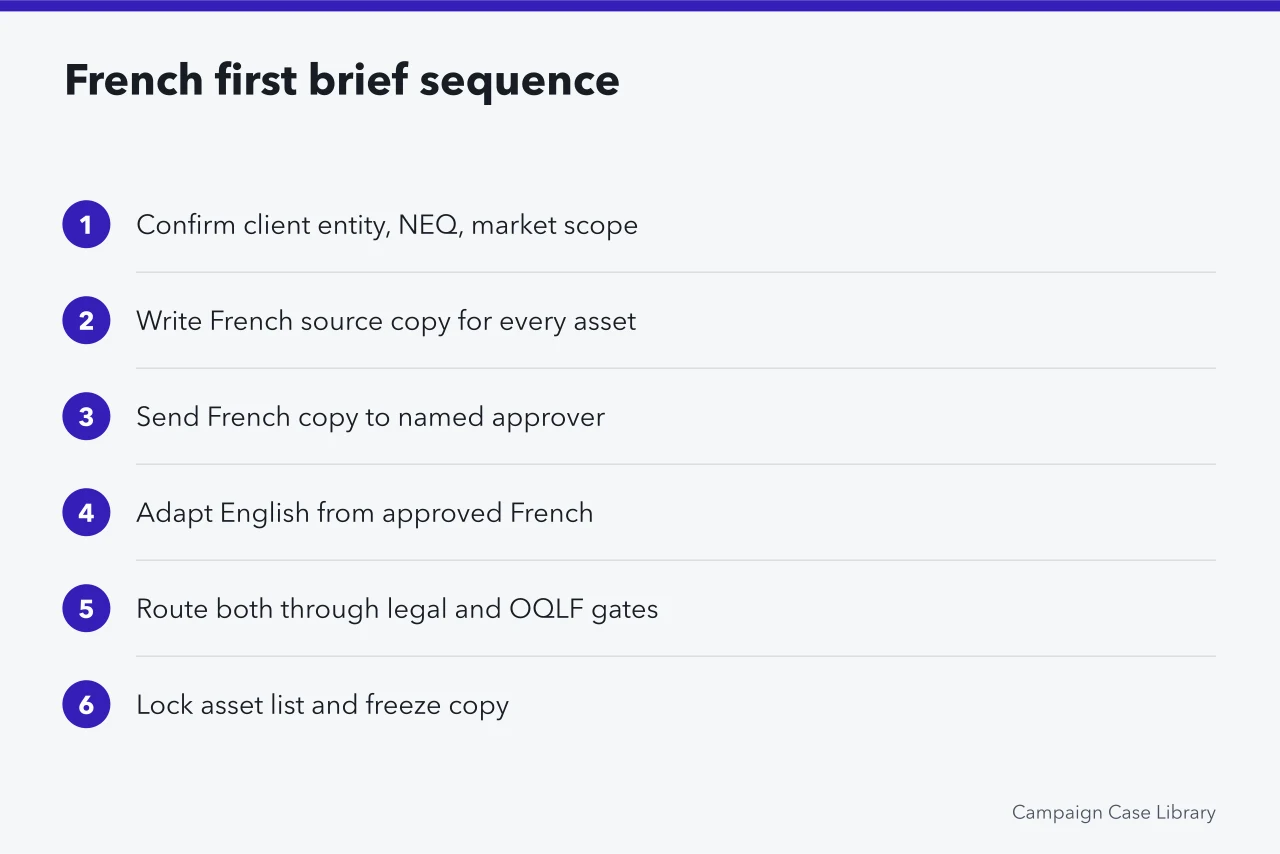
The order matters more than the tooling. A team can run this in a shared document or a project board, as long as the French gate is real and not a formality.
A good campaign brief template must contain the approval gate as a field, not a footnote. If the template has no place to record who approved the French, the approval will happen in a chat thread and vanish.
Treat the French source copy as the source of truth for claims, prices and offers. If the English version promises something the French does not, the campaign has two different offers in one market. That is a client problem and a compliance problem at once.
A francophone audience in Montreal is not the same as a bilingual audience, and the copy will differ. Naming the audience in the brief stops the team from defaulting to one version for everyone.
Where English fits
English is still necessary. Montreal campaigns often run in both languages, and some audiences respond better to English creative. The point is sequence, not exclusion.
Write the English version as an adaptation, not a translation. Idioms, humour and calls to action rarely survive a literal rendering, and a literal rendering is exactly what a rushed brief produces.
French review gates and the documents they cover
The review gates are internal checkpoints, not an OQLF pre-clearance step. The Office québécois de la langue française is the regulator that enforces the Charter of the French Language; it does not approve campaign copy before it runs. Put the gates in the brief as named checkpoints with an owner and a date, so the French content is defensible if a complaint ever lands.
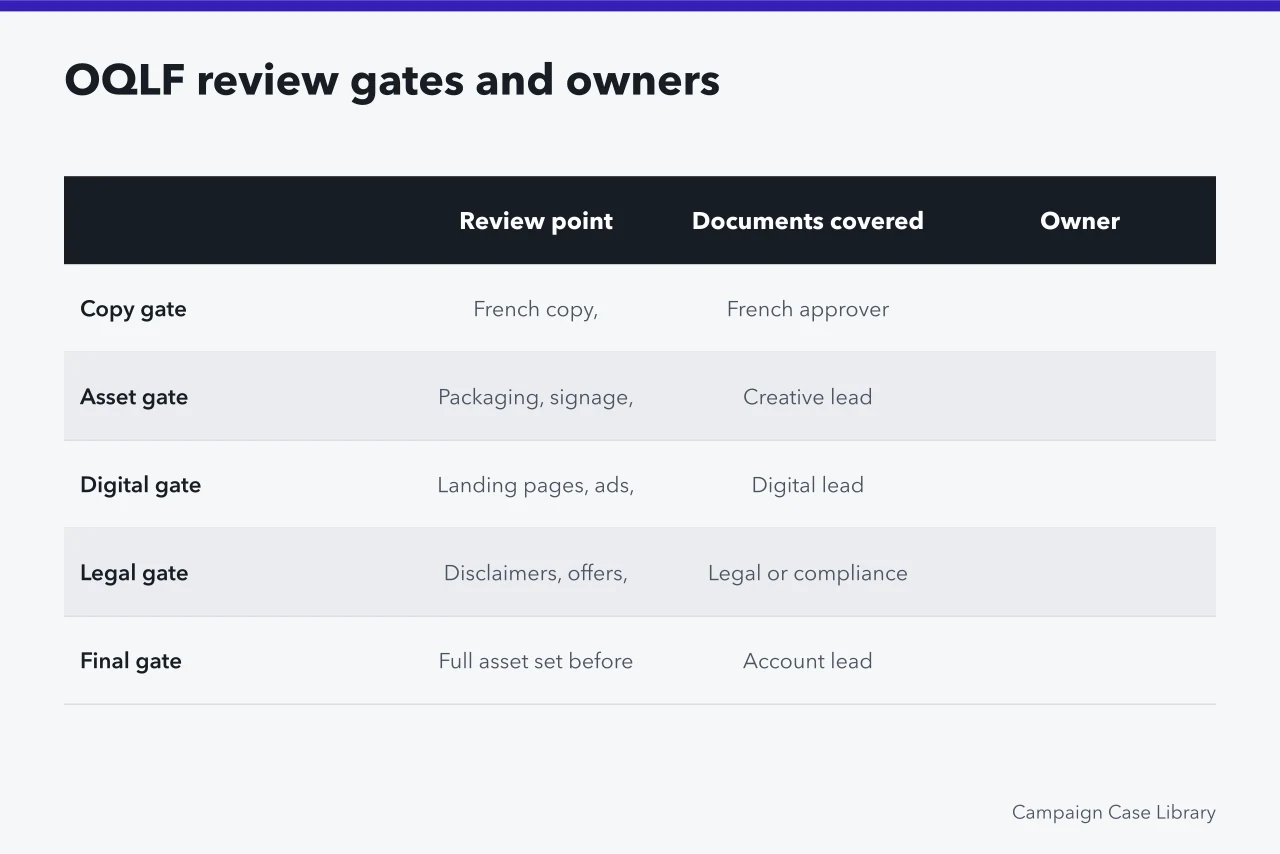
OQLF review points
| Gate | Owner | Date | Document |
|---|---|---|---|
| Copy gate | French copywriter plus the client's French approver | French copy due date | Approved French source copy, version 1 |
| Asset gate | Studio lead | Two working days before production release | In-store signage and out-of-home artwork |
| Digital gate | Paid social and email producer | Five working days before launch | Ad copy, email build and landing page text |
| Legal gate | Client legal reviewer | Before final client sign-off | Disclaimers and regulated claims, in both languages |
| Delivery gate | Account lead | Launch date minus one working day | Final asset list with the language noted per market |
Each gate needs a document the reviewer can actually open. A gate that points at a folder with twelve versions of a headline is not a gate, it is a delay.
Keep the review points proportional to the campaign. A single social post does not need five gates. A multi-channel launch with packaging and out-of-home does.
When the client operates outside Quebec, note which assets run where. French requirements apply to commercial content in Quebec, and the brief should make the geographic scope explicit rather than assumed.
Once the gates are defined, they carry across campaigns, and the team stops rebuilding the review structure every quarter.
Case example: a Montreal brief rebuilt for French first delivery
A Montreal agency took on a retail client with stores across the island and a smaller presence in Ontario. The first brief arrived in English only, with a line that said French translation to follow.
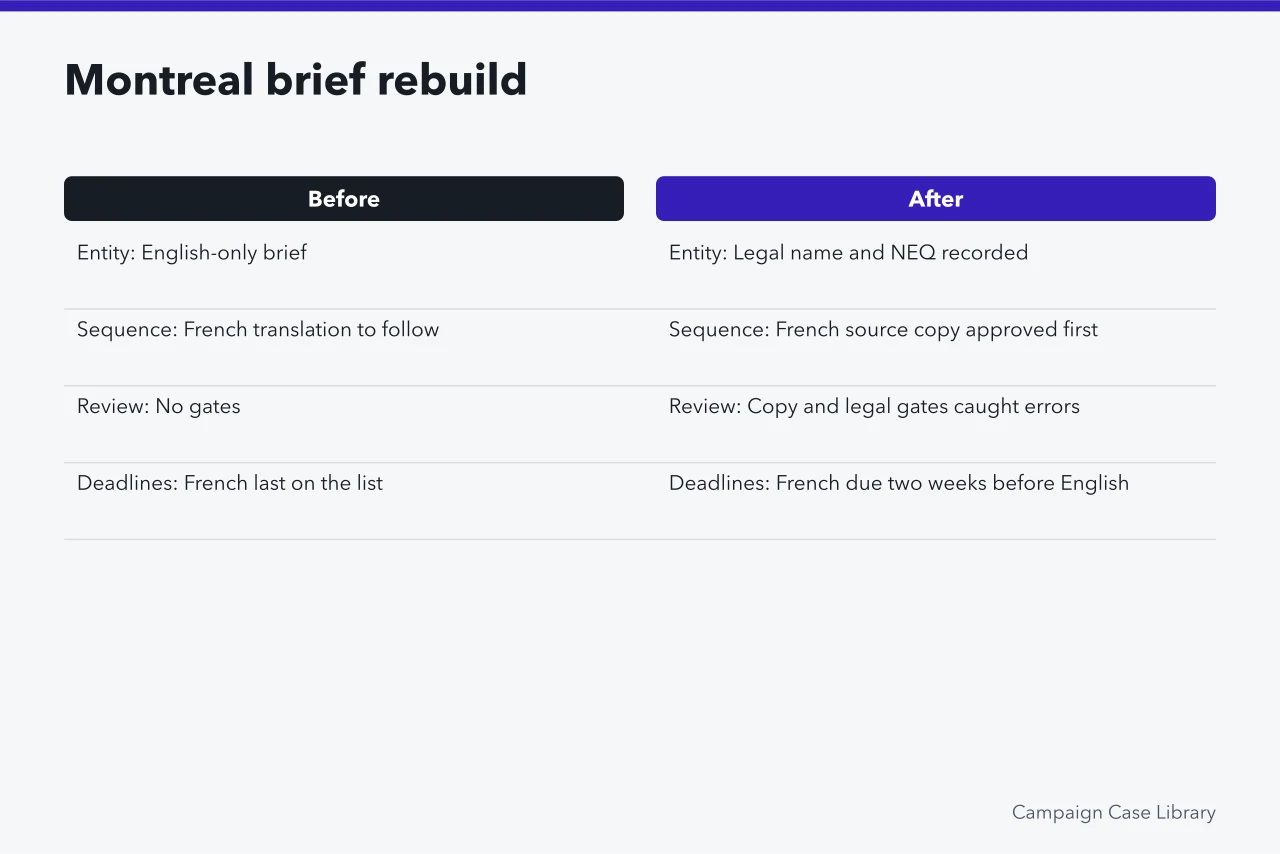
The campaign was a seasonal promotion with in-store signage, paid social, email and a landing page. The French arrived late, the English had already been approved, and the two versions drifted on the discount terms. The client caught it, not the agency.
The rebuild started with the entity. The team recorded the client's legal name and NEQ, then checked the market scope. Quebec stores were the priority, Ontario was secondary, and the brief said so.
Next came the sequence. The French source copy was written first and approved by the client's Montreal marketing manager. English adapted from it. Discount terms, dates and the offer matched in both versions because the English had nothing to invent.
The review points went in as gates. The copy gate caught one headline that read as a literal translation. The legal gate caught a disclaimer that existed only in English. Both fixes happened before production, which is the cheapest place to fix them.
The final change was the deadline structure. French copy was due two weeks before English, and the English deadline moved to match. The team stopped treating French as the last task on the list.
What the rebuild changed in rework and cycle time
The agency tracked rework rather than campaign performance. Fewer assets came back for copy changes after the rebuild, and the client's French approver stopped receiving last-minute requests.
Two counts are worth keeping: assets returned for copy changes after first review, and working days from the French copy due date to English sign-off. What those counts look like depends on channel count, how many client approvers sit on the campaign, and how early the French copy is frozen. The agency did not publish its own figures.
That is the realistic benefit. French first does not make campaigns creative. It stops the avoidable second pass.
Handling client feedback when French and English versions diverge
Divergence is normal. A client will change the English headline and leave the French alone, or the reverse. The brief needs a rule for what happens next.
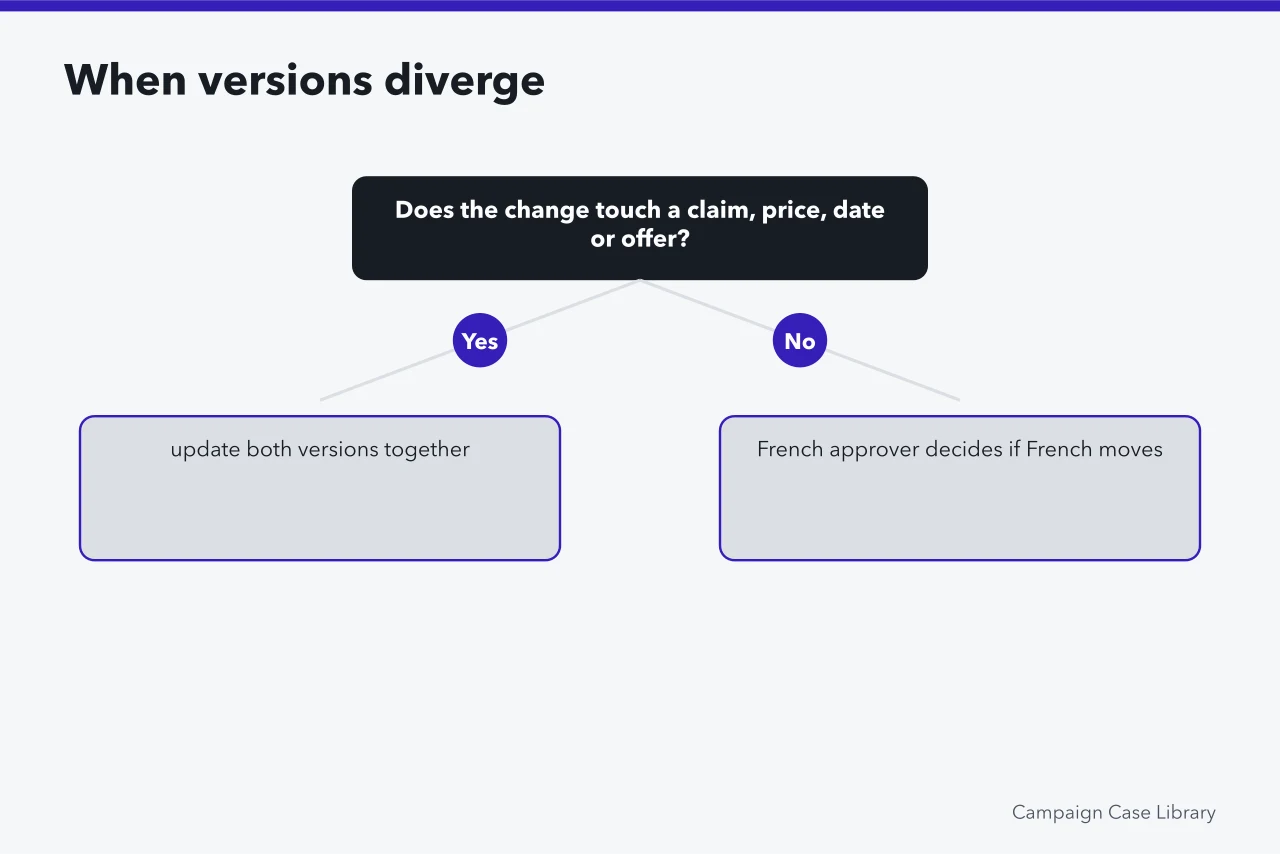
Record every change in the brief's version log, with who requested it and when. That log is the fastest way to answer a client who asks why the French says something different from the English.
When the two versions genuinely need to differ, write down why. A Quebec-specific promotion may not run in Ontario, and the copy should reflect that. An undocumented difference looks like an error, even when it is deliberate.
Watch for feedback that arrives in English about French copy. The person commenting may not read French well enough to judge the change. Route that feedback to the French approver rather than applying it directly.
If the version log lives inside the template, nobody has to remember to keep a separate record.
Escalation
Set a threshold for escalation. If a change touches regulated claims or legal disclaimers, it goes to legal regardless of who requested it. Everything else can stay with the account team.
Checklist before a Montreal brief leaves the building
Run this before the brief goes to the client or into production. It takes minutes and prevents the most common failures.
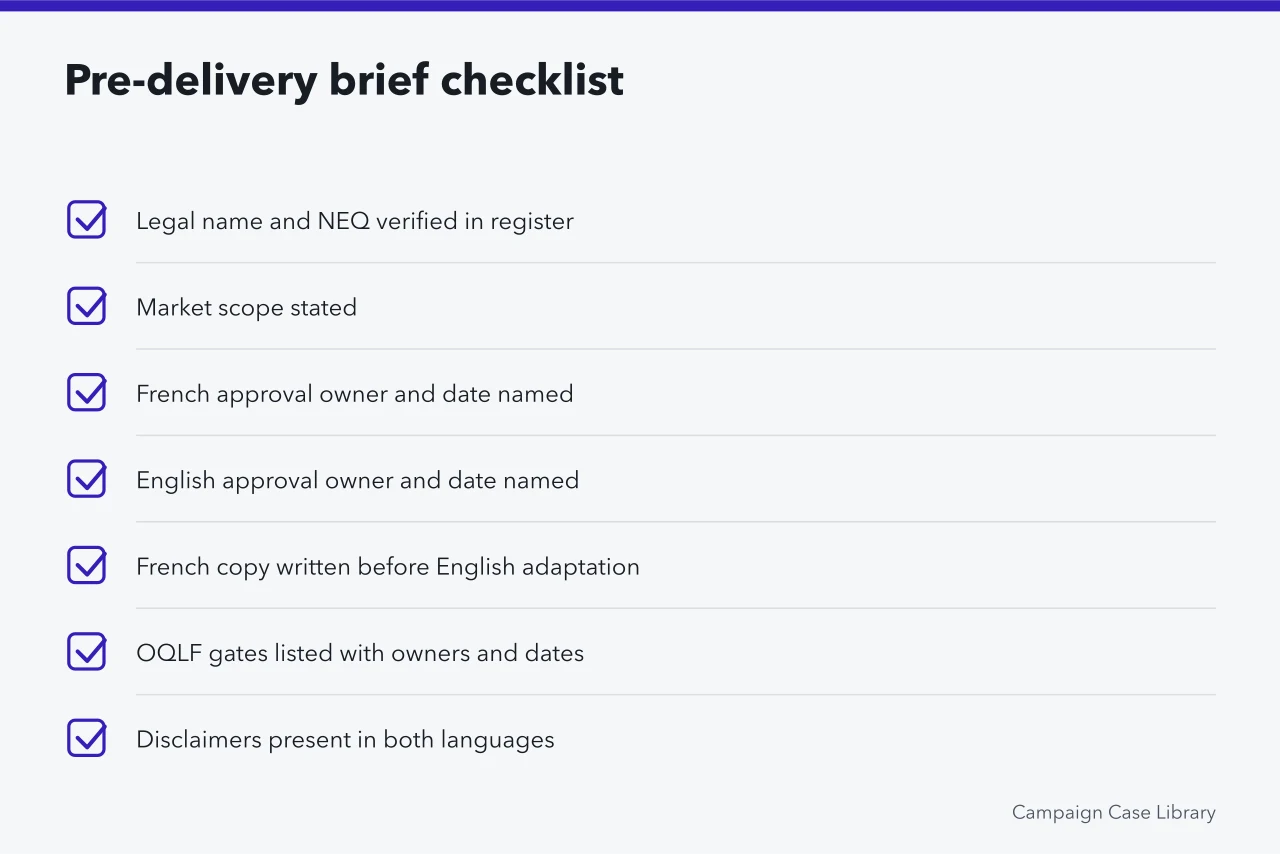
- Client legal name and NEQ recorded and checked in the register.
- Market scope statedQuebec only, or Quebec plus each named province.
- French approval owner named, with a contact and a review window.
- English approval owner named, with a contact.
- French copy approved before the English version is finalized.
- Disclaimers present in French and in English, pasted in full.
- Regulated claims flagged and routed to legal.
- Version log started, one row per change, with the requester named.
- Asset list matches every channel in the brief, with the language noted per market.
Two items on that list cause most of the trouble. The missing approver and the missing disclaimer. Both are cheap to fix on the brief and expensive to fix after launch.
Keep the checklist attached to the template. A checklist stored somewhere else gets skipped when the deadline moves.
If the client works across several provinces, add a line for each market and confirm which language rules apply. Quebec is the strictest case, but the brief should show the team has thought about the others.