
Guides
Pricing localization projects in Canadian dollars from Toronto to Halifax
Localization pricing in Canadian dollars shifts by city and province, from Toronto and Calgary rate cards to Montreal tax rules and Halifax HST charges.
What to take away
- A rate card is a local document. Toronto prices against Bay Street clients, Montreal against Quebec's French-first market, Halifax against thin translator supply.
- Tax follows the client's province, not your office. Ontario HST is 13 percent, Quebec is GST 5 percent plus QST 9.975 percent, Alberta is GST 5 percent, Nova Scotia HST is 15 percent.
- Certification is provincial. ATIO covers Ontario, OTTIAQ covers Quebec, and CTTIC member bodies cover the rest, so a certified translator in one province is not automatically accepted in another.
- A USD contract needs the currency, the rate source and the review band stated in the quote.
- Repricing needs a trigger written down in advancetwo quarters below target margin, a scope creep threshold, or a currency move that holds for a full quarter.
Rate cards compared across Toronto, Montreal, Calgary and Halifax
A rate card is not a national document. Each office prices against its own labour market, its own language demand and its own provincial tax. The four cities below cover most of the Canadian work an agency will quote in a year.
Canadian City Rate Cards
Toronto
- Common pairs
- EN-FR, Mandarin, Punjabi
- Per-word level
- Mid to high
- Tax on invoices
- HST 13%
- Certifying body
- ATIO
Montreal
- Common pairs
- FR-EN, EN-FR, Arabic
- Per-word level
- Mid, legal premium
- Tax on invoices
- GST 5% + QST 9.975%
- Certifying body
- OTTIAQ
Calgary
- Common pairs
- EN-FR, Tagalog, Spanish
- Per-word level
- Mid
- Tax on invoices
- GST 5%
- Certifying body
- ATIA
Halifax
- Common pairs
- EN-FR, Arabic, Mandarin
- Per-word level
- Mid to high
- Tax on invoices
- HST 15%
- Certifying body
- CTTIC member
Rate cards compared
Common pairs
- Toronto
- English to French, Mandarin, Punjabi
- Montreal
- French to English, English to French, Arabic
- Calgary
- English to French, Tagalog, Spanish
- Halifax
- English to French, Arabic, Mandarin
Typical per-word rate (CAD)
- Toronto
- 0.20 to 0.28
- Montreal
- 0.18 to 0.26; French legal 0.25 to 0.35
- Calgary
- 0.17 to 0.24
- Halifax
- 0.20 to 0.28; scarce pairs 0.28 to 0.40
Tax on invoices
- Toronto
- HST 13%
- Montreal
- GST 5% plus QST 9.975%
- Calgary
- GST 5%
- Halifax
- HST 15%
Certifying body
- Toronto
- ATIO
- Montreal
- OTTIAQ
- Calgary
- ATIA
- Halifax
- CTTIC member
Per-word figures are typical English to French commercial ranges in CAD, quoted before tax. Certified, legal and scarce-pair work prices above those bands.
Toronto
Toronto rates sit at the top of the English Canadian market. The city holds the deepest pool of financial, legal and life sciences buyers, and the largest volume of regulated French work under the federal Official Languages Act.
A Toronto card needs separate lines for certified translation, standard commercial work and machine-output post-editing. Many US clients place their Canadian work here, so the same card often carries a USD column. Keep that column separate from the CAD column.
Montreal
Montreal is a bilingual market, not a translated one. French to English and English to French are both core products, and Quebec buyers expect French first. French copywriting, revision and terminology work belong on the card as billable lines, not overhead.
French legal and regulatory text prices above the city average. Quebec's Charter of the French Language drives demand for French versions of packaging, software and public-facing documents. Buyers compare quotes against local suppliers who already know that market.
Calgary
Calgary prices closer to the national middle. Energy, engineering and agriculture clients dominate, and their documents are technical rather than legal. That favours per-word rates with a technical surcharge over an hourly minimum.
Alberta has no provincial sales tax, so a Calgary quote shows GST only. The tax line on the invoice is simpler than an Ontario or Nova Scotia one, which helps on cross-border work.
Tagalog and Arabic demand has grown with immigration, and those pairs are priced by supply.
Halifax
Halifax has fewer translators per language pair, so scarce pairs cost more than the same pair in Toronto. English to French is well supplied. Arabic, Mandarin and legal French are not.
Nova Scotia's HST is 15 percent, the highest of the four cities. A Halifax client comparing your quote with a Toronto one sees a two-point tax difference on the same subtotal. Show the tax line clearly and let the comparison be honest.
Cost drivers that move language localization quotes in Canada
Word count is the starting point, not the price. Six drivers move a Canadian quote more than volume does, and each belongs on the quote as its own line or a stated multiplier.
Worked Quote Breakdown
- 2,880 CADTranslation 12,000 words at 0.24
- 432 CADTechnical surcharge 15 percent
- 600 CADLocalisation engineering
- 350 CADSecond-translator review
Cost drivers
- Provincial certificationATIO in Ontario, OTTIAQ in Quebec and CTTIC member bodies elsewhere each set their own admission route and their own fee for signed, stamped work.
- French-first requirements in Quebecthe Charter of the French Language makes the French version primary, so French copywriting, revision and terminology are billable lines.
- Federal Translation Bureau accreditationa federal supply arrangement prices federal files against that credential, and the credential does not carry into provincial work.
- Translator supply by city and pairscarce pairs in Halifax cost more than the same pair in Toronto, and the card has to reflect the local pool.
- Provincial wage levelstranslator and reviser cost per hour varies by province, and the per-word rate has to cover it.
- Place of supply for taxthe client's province sets which tax applies, and the tax is not part of the rate.
A worked example
A Toronto agency quotes a 12,000-word English to French software localisation for a Montreal client. The lines break down like this.
- Translation12,000 words at 0.24 CAD, giving 2,880 CAD.
- Technical surcharge15 percent on translation, adding 432 CAD.
- Localisation engineering for string files600 CAD.
- Second-translator review350 CAD.
Subtotal 4,262 CAD. Montreal tax is GST 5 percent plus QST 9.975 percent, so the total is about 4,900 CAD. A USD payment needs the exchange basis stated in the quote.
That example is the shape of every Canadian quote. The variables change, the lines do not. Owners who track these lines separately can see which one is eroding margin, which is the discipline behind charging properly for translation agency services.
Provincial certification differences that affect pricing
Certification is provincial, and that is a pricing fact, not a legal footnote. Ontario recognises ATIO. Quebec recognises OTTIAQ. The other provinces and territories are served by CTTIC member bodies, and each sets its own admission route.
Provincial Certification Bodies
Ontario
- Recognised body
- ATIO
- Acceptance
- Ontario courts, ministries
- Pricing impact
- Certified translation fee
Quebec
- Recognised body
- OTTIAQ
- Acceptance
- Quebec courts, ministries
- Pricing impact
- Certified translation fee
Other provinces
- Recognised body
- CTTIC member
- Acceptance
- Provincial offices
- Pricing impact
- Certified translation fee
A certified translator in Ontario is not automatically a certified translator in Quebec. For a client who needs a document accepted by a provincial court, a ministry or an immigration office, the province of the certifying body decides. Getting this wrong means a redo at your cost.
The federal Translation Bureau buys in a different market again, with its own supplier accreditation. Agencies that hold a federal supply arrangement can price federal work against that credential. It does not transfer to provincial files.
What to put on the rate card
List certification as a separate service with a separate fee. State which body certifies the translator and which provinces accept the document. If a client needs acceptance in two provinces, quote two certified copies, or a certified copy plus a notarised version.
This is where Canadian pricing differs most from US practice. American certification is often a single national credential. Canadian buyers ask which province, and the answer changes the price.
Exchange-rate swings with US clients and how to quote
A US client paying in USD is your best and most exposed account. When the loonie weakens, your CAD revenue rises on the same USD invoice. When it strengthens, the same invoice buys less. Neither move is under your control, so the quote has to absorb it.
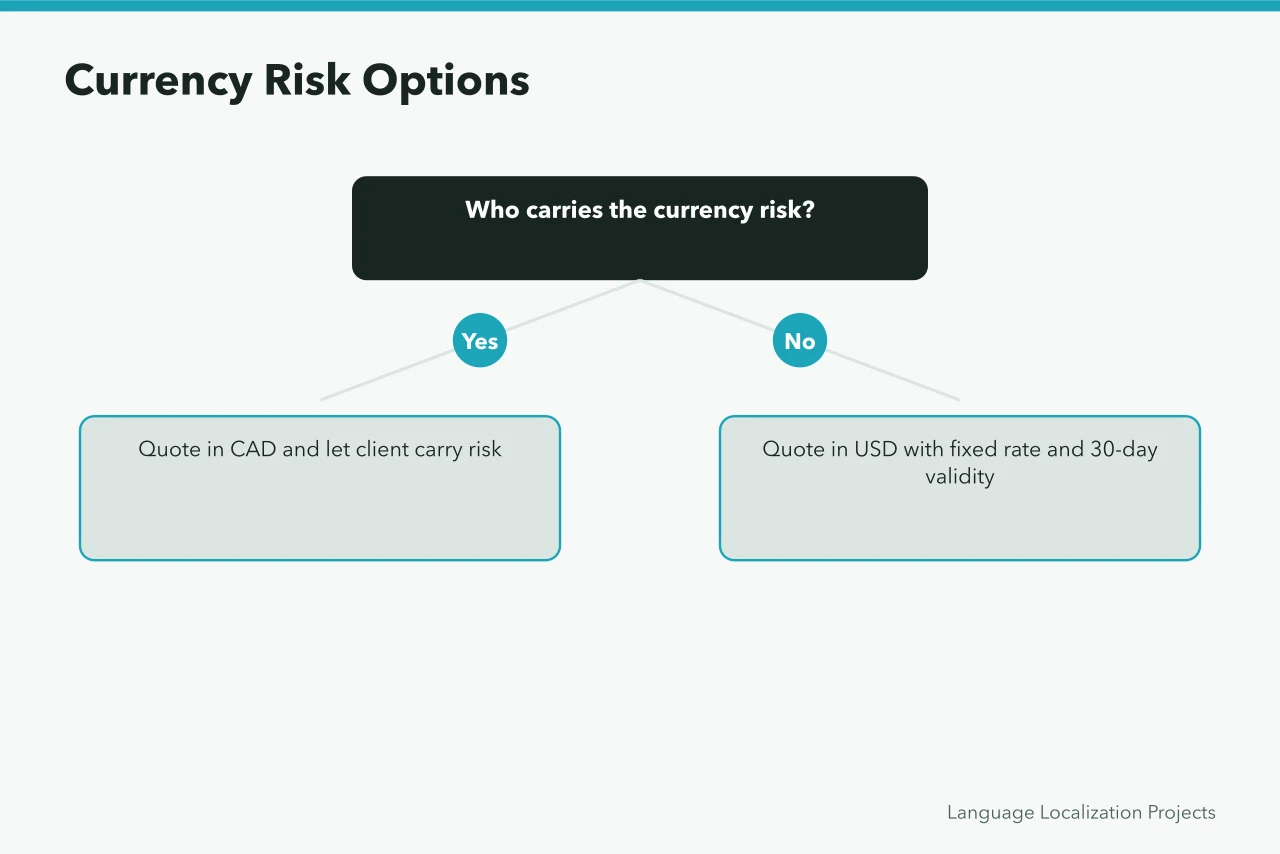
Three clauses do most of the work. Name the currency of the contract. Name the exchange basis, either the Bank of Canada rate on the invoice date or a rate fixed in the quote. Name what happens if the rate moves more than 3 percent from the rate in the quote before payment.
Practical options
- Quote in CAD and let the client carry the currency risk.
- Quote in USD with a fixed conversion rate and a validity period of 30 days.
- Quote in USD with a monthly true-up if the rate moves more than 3 percent from the rate fixed in the quote.
- Invoice in USD and hold the balance in a USD account to reduce conversion costs.
The right choice depends on how much of your cost base is in CAD. It usually is most of it. The same logic applies to your own books, and the habits in translation agency service packages make the swings visible before they hurt.
Federal supports for firms serving US clients exist, and the Canada-United States overview is the place to check what applies to your situation. Most are aimed at exporters of goods, but the trade and tariff context still shapes how US buyers negotiate.
GST/HST and provincial tax treatment in Canadian-dollar quotes
Canadian quotes show tax separately. The rate depends on the place of supply and the client's status, not on where your office sits.
Provincial Tax on Translation
Ontario/Toronto
- Tax type
- HST
- Rate
- 13 percent
- Exports to US
- Zero-rated
Quebec/Montreal
- Tax type
- GST + QST
- Rate
- 5 + 9.975 percent
- Exports to US
- Zero-rated
Alberta/Calgary
- Tax type
- GST
- Rate
- 5 percent
- Exports to US
- Zero-rated
Nova Scotia/Halifax
- Tax type
- HST
- Rate
- 15 percent
- Exports to US
- Zero-rated
Provincial tax treatment
| Province or city | Tax on translation services | Rate |
|---|---|---|
| Ontario, including Toronto | HST | 13 percent |
| Quebec, including Montreal | GST plus QST | 5 percent plus 9.975 percent |
| Alberta, including Calgary | GST | 5 percent |
| Nova Scotia, including Halifax | HST | 15 percent |
| Other provinces | GST, or HST where applicable | 5 percent, or the provincial HST rate |
Ontario's HST applies to translation and localisation services supplied to Ontario clients. A Toronto agency invoices HST to Ontario clients and GST plus QST to Quebec ones. Check the province's published HST guidance before you set a rate card, because the place-of-supply rule decides the rate.
Exports are the exception. A translation supplied to a US business client is generally zero-rated, which means you charge no GST/HST but still report the sale. A US-heavy client list can leave a Canadian agency with low input tax credits and a cash-flow gap between filing periods.
Registration is required once revenue passes the small-supplier threshold.
The CRA page on how to file a GST/HST return explains the reporting mechanics, including how to file a nil or credit return when you have more tax paid than collected.
Business taxes in Canada are administered mostly through the CRA, and the cross-border tax points matter if you buy services from US subcontractors.
Keep the tax line out of your margin calculation. A 13 percent HST charge is not revenue. Agencies that quote a single all-in number and then discover the tax inside it are pricing 13 percent below where they thought.
Building a quote template that survives a weak loonie
A quote template is a risk document as much as a sales document. It should carry the rate, the currency, the tax treatment, the validity period and the review trigger on one page. The structure in a translation agency quote template works in Canada with three additions: a tax line, a currency clause and a certification line.
Canadian Quote Template Fields
- Client legal name and province of supply
- Currency and exchange basis
- Tax treatment and registration numbers
- Language pair, direction and word count
- Certification body and province of acceptance
- Validity period and repricing trigger
- Payment terms and late-payment interest
Build the template around the cost drivers, not around the client's budget. Each driver gets a line, and each line has a unit and a rate. When a client pushes back, you can move one line instead of cutting the whole price.
Fields every Canadian quote needs
- Client legal name and province of supply
- Currency and exchange basis
- Tax treatment and registration numbers
- Language pair, direction and word count
- Certification body and province of acceptance
- Validity period and repricing trigger
- Payment terms and late-payment interest
The weak-loonie test
Run every template through a 10 percent adverse currency move before you send it. If the account turns unprofitable at that point, the quote is too thin. The fix is a higher USD rate, a CAD-denominated contract or a shorter validity period.
A weak loonie also raises the cost of any US subcontractor you use, so the test has to cover both sides. Agencies that price only the revenue side get caught when a US proofreader's invoice converts at a worse rate than the one baked into the quote.
The margin discipline in a pricing and profit guide applies here in full.
When to reprice an existing localization projects account
Repricing an account is a decision with a trigger, not a mood. Set the triggers in advance and apply them without argument.
Repricing Triggers
- Below target margin for two consecutive quarters
- Scope grown beyond stated percentage without rate change
- Language mix shifted to scarcer or technical pairs
- Turnaround tightened beyond original terms
- Currency cut USD revenue below CAD cost base
- Translator costs risen and rate card unchanged
When to reprice
- The account has run below target margin for two consecutive quarters.
- The scope has grown by more than a stated percentage without a rate change.
- The language mix has shifted toward scarcer or more technical pairs.
- Turnaround expectations have tightened beyond the original terms.
- Currency movement has cut USD revenue below the CAD cost base for a full quarter.
- Your own translator costs have risen and the rate card has not.
How to have the conversation
Canadian agency contracts here usually run month to month or on a quarterly cycle. Give one billing cycle of notice: 30 days on a monthly term, 60 days on a quarterly one. Show the client the driver that changed, not a general cost increase.
Offer a scope option that keeps the old rate, such as a longer deadline or a lighter review step.
Expect some attrition. An account priced below cost is not an asset, and the capacity it frees can go to work priced at the current card. Track the change in your books so you can see whether the repricing held.
Where the market data comes from
Canadian language demand is not guesswork.
Statistics Canada's 2021 Census of Population, released in August 2022, publishes community-level language and immigration data that shows where French, Mandarin, Punjabi, Tagalog and Arabic speakers live and work. That data supports a rate card by city, because it shows which pairs are genuinely local and which are served remotely.
Statistics Canada's Labour Force Survey, published monthly, reports average weekly earnings by province and industry. Wages and labour costs are the other half of the picture, and they vary by city as much as rates do.
Common questions
Do I charge HST to a US client?
Generally no. A translation supplied to a non-resident business is usually zero-rated, so you charge no GST/HST but still report the sale on your return. Confirm your own position with the CRA or an accountant.
Can a Toronto-certified translator sign a document for a Quebec court?
Not automatically. Certification is provincial, and Quebec recognises OTTIAQ. Check the accepting authority before you promise a certified translation.
Should Canadian quotes be in CAD or USD?
Either, as long as the currency and exchange basis are stated. CAD shifts currency risk to the client; USD keeps the price familiar but puts the risk on your margin.
How often should I update my rate card?
At least once a year, and sooner if translator costs or the exchange rate move sharply. A card with a stated review date is easier to defend than one updated at random.